> ## Documentation Index
> Fetch the complete documentation index at: https://docs.opendot.ai/llms.txt
> Use this file to discover all available pages before exploring further.
# Dot device
> Understand the current Dot firmware, Waveshare reference hardware, and coming open hardware direction.
The Dot device is the hardware target for OpenDot voice agents. Today it is a
firmware-first prototype that runs on a tested reference development board. The
longer-term goal is open hardware for a purpose-built Dot device, but the current
docs should stay honest about what has actually been tested.
You do not need a physical device to use OpenDot Platform! Start in the web app, make
the platform reliable, then bring the same agent to hardware when you are ready.
## Current reference board
OpenDot firmware currently targets the
[Waveshare ESP32-S3-AUDIO-Board](https://www.waveshare.com/esp32-s3-audio-board.htm).
This is the board tested so far for the local Dot device flow.
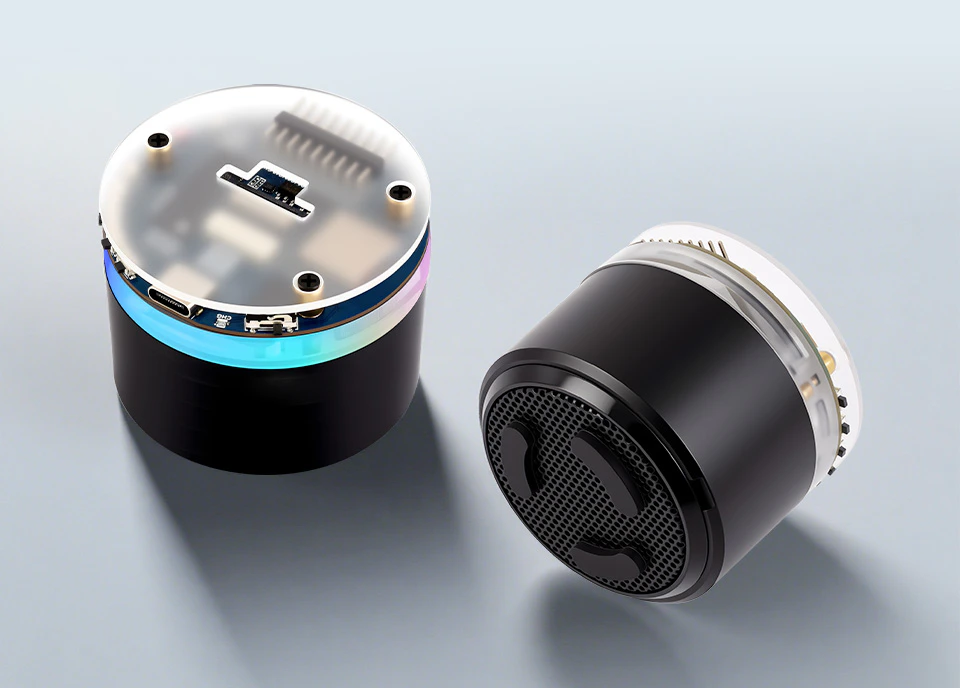 The board is useful for OpenDot because it puts the important voice-device
pieces in one small package:
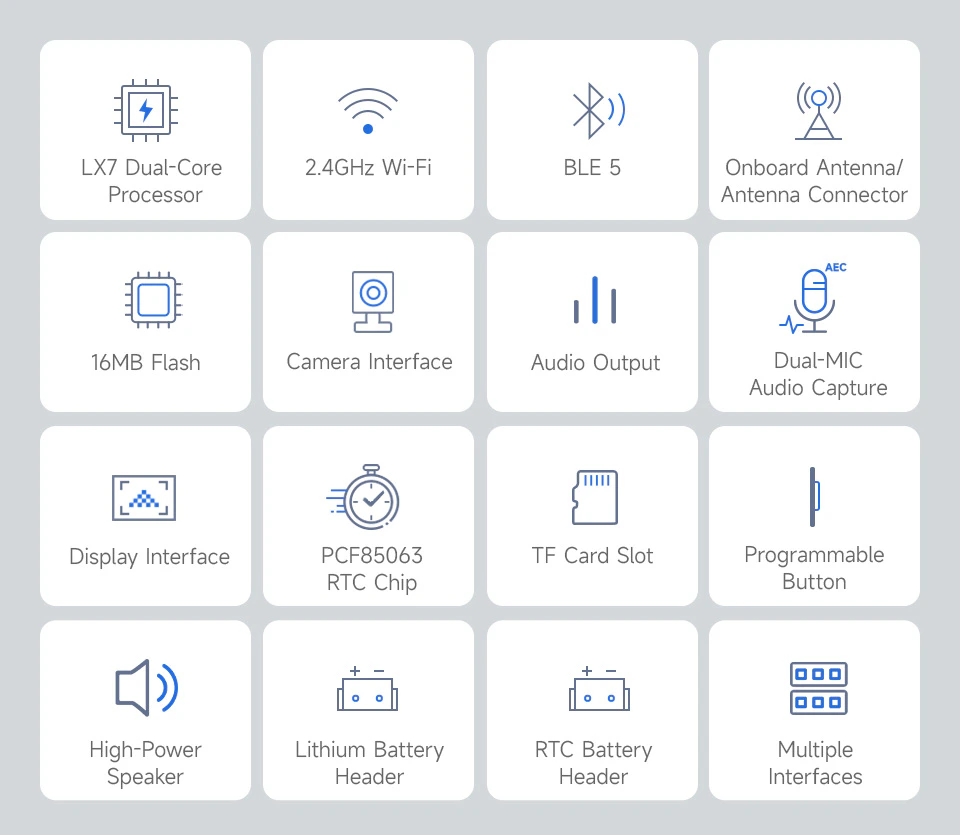
* ESP32-S3R8 MCU with 2.4 GHz Wi-Fi and Bluetooth LE
* 8 MB PSRAM and 16 MB external flash
* dual microphones for voice input
* ES7210 and ES8311 audio path for microphone input and speaker output
* speaker header and audio enclosure
* RGB LED ring, buttons, USB-C, TF card slot, battery support, and expansion
connectors
The board is useful for OpenDot because it puts the important voice-device
pieces in one small package:
* ESP32-S3R8 MCU with 2.4 GHz Wi-Fi and Bluetooth LE
* 8 MB PSRAM and 16 MB external flash
* dual microphones for voice input
* ES7210 and ES8311 audio path for microphone input and speaker output
* speaker header and audio enclosure
* RGB LED ring, buttons, USB-C, TF card slot, battery support, and expansion
connectors
 ## Firmware shape
The firmware lives in `dot-device/firmware/` and is an ESP-IDF project, not an
Arduino sketch. It currently handles:
* Wi-Fi provisioning through a temporary `opendot-...` access point
* OTA bootstrap through `CONFIG_OTA_URL`
* activation code speech and claim flow through the OpenDot runtime and platform
API
* wake-word behavior
* WebSocket connection to the runtime
* microphone capture and speaker playback
* display and LED status
The active board definition is:
```text theme={null}
dot-device/firmware/main/boards/waveshare/esp32-s3-audio-board
```
The firmware is an OpenDot fork/adaptation of the MIT-licensed
[78/xiaozhi-esp32](https://github.com/78/xiaozhi-esp32) project. Preserve the
upstream notice in `dot-device/firmware/LICENSE.xiaozhi` when moving or
substantially modifying firmware code.
## Runtime relationship
The device does not connect to the browser UI. It connects to the local or hosted
OpenDot runtime:
```text theme={null}
http://:8787/ota/
ws://:8787/ws
```
Activation works like this:
1. Firmware boots and reaches the runtime OTA endpoint.
2. The runtime proxies activation to the platform API.
3. The platform API creates or verifies an activation request.
4. The device speaks a claim code.
5. The user enters that code in [Dot Device](/dot-device).
6. The platform stores a device credential.
7. Subsequent `/ws` sessions authenticate with that credential and load the
bound identity configuration.
The firmware protocol does not change when the bound identity uses
Speech-to-speech. The device still sends authenticated Opus audio over `/ws` and
plays Opus frames from the runtime. The runtime checks the bound agent
architecture: Sandwich routes through Deepgram plus the configured LLM and TTS,
while Speech-to-speech opens a server-side OpenAI Realtime WebSocket with the
runtime's `OPENAI_API_KEY`.
## Hardware interface reference
The reference board exposes more than OpenDot uses today. The important areas for
contributors are audio I/O, display, buttons, LEDs, Wi-Fi, power, and runtime
network reachability.
## Firmware shape
The firmware lives in `dot-device/firmware/` and is an ESP-IDF project, not an
Arduino sketch. It currently handles:
* Wi-Fi provisioning through a temporary `opendot-...` access point
* OTA bootstrap through `CONFIG_OTA_URL`
* activation code speech and claim flow through the OpenDot runtime and platform
API
* wake-word behavior
* WebSocket connection to the runtime
* microphone capture and speaker playback
* display and LED status
The active board definition is:
```text theme={null}
dot-device/firmware/main/boards/waveshare/esp32-s3-audio-board
```
The firmware is an OpenDot fork/adaptation of the MIT-licensed
[78/xiaozhi-esp32](https://github.com/78/xiaozhi-esp32) project. Preserve the
upstream notice in `dot-device/firmware/LICENSE.xiaozhi` when moving or
substantially modifying firmware code.
## Runtime relationship
The device does not connect to the browser UI. It connects to the local or hosted
OpenDot runtime:
```text theme={null}
http://:8787/ota/
ws://:8787/ws
```
Activation works like this:
1. Firmware boots and reaches the runtime OTA endpoint.
2. The runtime proxies activation to the platform API.
3. The platform API creates or verifies an activation request.
4. The device speaks a claim code.
5. The user enters that code in [Dot Device](/dot-device).
6. The platform stores a device credential.
7. Subsequent `/ws` sessions authenticate with that credential and load the
bound identity configuration.
The firmware protocol does not change when the bound identity uses
Speech-to-speech. The device still sends authenticated Opus audio over `/ws` and
plays Opus frames from the runtime. The runtime checks the bound agent
architecture: Sandwich routes through Deepgram plus the configured LLM and TTS,
while Speech-to-speech opens a server-side OpenAI Realtime WebSocket with the
runtime's `OPENAI_API_KEY`.
## Hardware interface reference
The reference board exposes more than OpenDot uses today. The important areas for
contributors are audio I/O, display, buttons, LEDs, Wi-Fi, power, and runtime
network reachability.
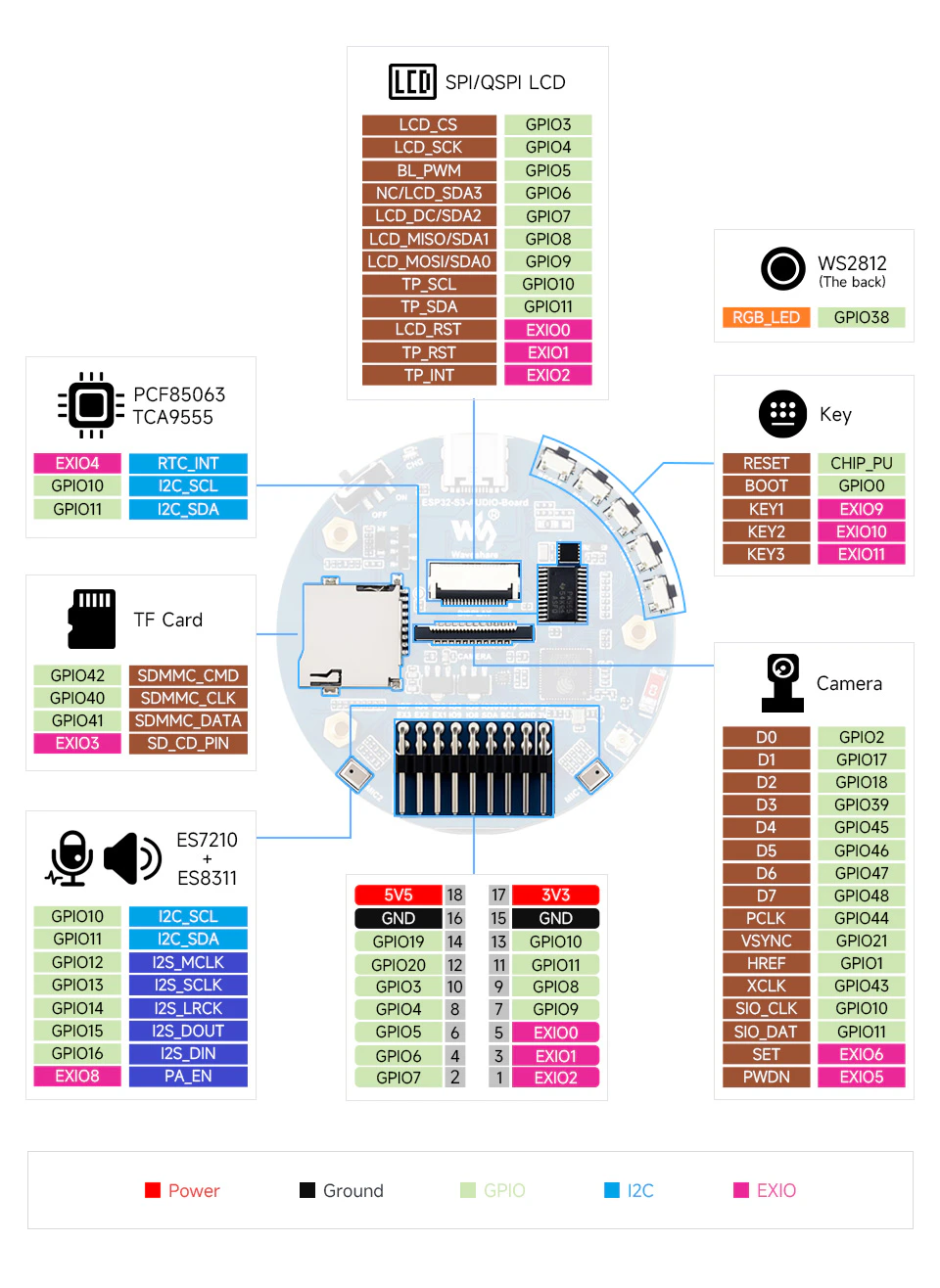 Use this map when checking pin assumptions against firmware board files such as
`config.h`, but treat OpenDot's firmware source as the contract for the current
prototype.
## Hardware coming soon
The future open hardware Dot device should keep the same product constraints
visible:
* reliable near-field and practical far-field capture
* speaker output that makes TTS testing honest
* physical status through light, display, or both
* simple power, battery, and USB debugging paths
* casing and acoustic choices that do not hide microphone or speaker behavior
* reproducible firmware flashing and serial diagnostics
Until that hardware exists, the Waveshare board is the reference target for
firmware bring-up and end-to-end device activation.
## Contributor checklist
When changing device-facing behavior, check both sides of the boundary:
* [Dot Device console](/dot-device) for the console pairing and binding workflow
* [Platform architecture](/architecture) for OTA, credential, runtime, and
data-model ownership
* `dot-device/firmware/README.md` for ESP-IDF setup, flashing, provisioning, and
serial monitoring
* `dot-device/firmware/main/boards/waveshare/esp32-s3-audio-board/` for the
current board definition
Use this map when checking pin assumptions against firmware board files such as
`config.h`, but treat OpenDot's firmware source as the contract for the current
prototype.
## Hardware coming soon
The future open hardware Dot device should keep the same product constraints
visible:
* reliable near-field and practical far-field capture
* speaker output that makes TTS testing honest
* physical status through light, display, or both
* simple power, battery, and USB debugging paths
* casing and acoustic choices that do not hide microphone or speaker behavior
* reproducible firmware flashing and serial diagnostics
Until that hardware exists, the Waveshare board is the reference target for
firmware bring-up and end-to-end device activation.
## Contributor checklist
When changing device-facing behavior, check both sides of the boundary:
* [Dot Device console](/dot-device) for the console pairing and binding workflow
* [Platform architecture](/architecture) for OTA, credential, runtime, and
data-model ownership
* `dot-device/firmware/README.md` for ESP-IDF setup, flashing, provisioning, and
serial monitoring
* `dot-device/firmware/main/boards/waveshare/esp32-s3-audio-board/` for the
current board definition